
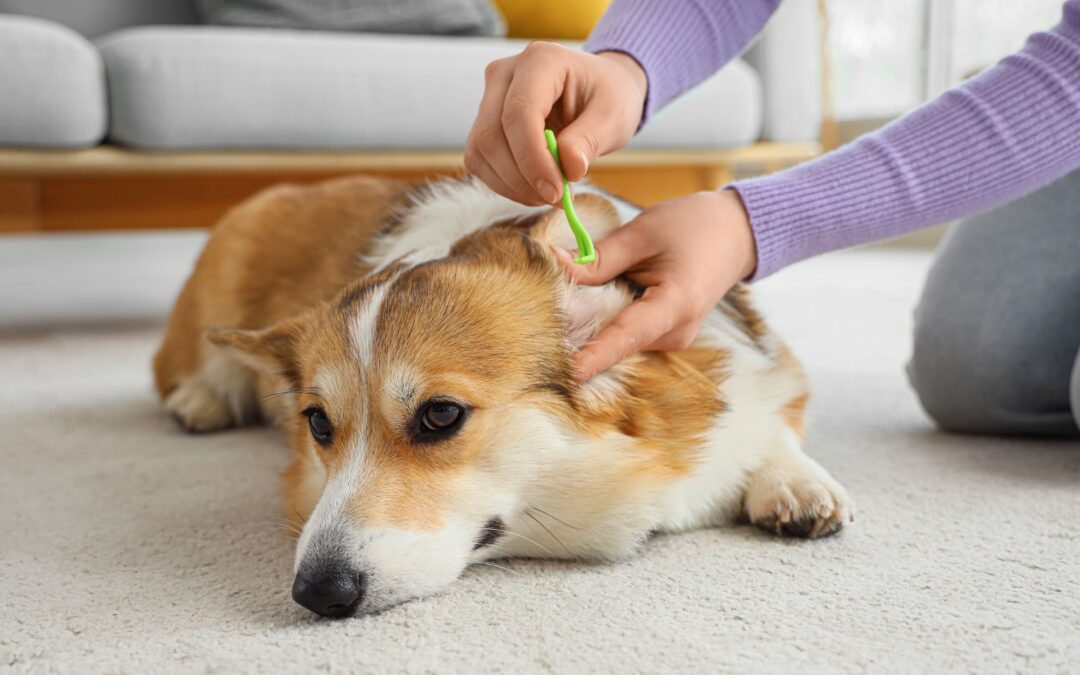
To remove an attached tick, wear gloves and use fine-tipped tweezers to grasp it as close to your dog’s skin as possible. Pull upward using slow, steady pressure without squeezing or twisting the tick. After removal, clean the bite area and wash your hands thoroughly. This method follows guidance from the Merck Veterinary Manual and the Companion Animal Parasite Council.
Finding a tick on your dog can be unsettling, especially after walking through wooded, brushy, or grassy areas around Ridgefield, Connecticut. Remove an attached tick promptly because disease-transmission times vary by tick species and pathogen. There is no universal waiting period during which an attached tick is guaranteed to be harmless.
This guide explains how to check your dog, remove a tick safely, handle retained mouthparts, recognize warning signs, and reduce future tick exposure.
How to Check Your Dog for Ticks
Check your dog for ticks by slowly running your hands over the entire body and feeling for small bumps attached to the skin. Do this after any time outdoors, especially in wooded or grassy areas, and preferably before your dog comes inside. Ticks can be as small as 1 mm, roughly the size of a poppy seed, so they are easy to miss if you rely only on a visual scan. A careful, hands-on check every time is one of the simplest habits you can build for your dog’s long-term health.
Pay extra attention to spots where ticks prefer to hide. They gravitate toward warm, moist areas and places where skin meets at a tight fold. These tend to be the locations owners overlook most during a quick pat-down.
Key Areas to Check
- In and around the ear flaps and inside the ear canal opening
- Under the collar and around the neck
- Between the toes and around the paw pads
- Under the front legs (armpits)
- Between the back legs and around the groin
- Around the tail and base of the tail
- Around each eyelid
If your dog has thick or long fur, a flea comb can help you part the coat and get a closer look at the skin surface. A flea comb will not remove an attached tick, but it makes spotting one significantly easier in dense-coated breeds.
How to Remove a Tick from a Dog Step by Step
Safe tick removal requires the right tool, a firm grip near the skin, and one slow, controlled upward motion. Use fine-tipped tweezers or a purpose-made tick removal tool, and avoid twisting, jerking, or squeezing the tick’s body. Once it is removed, gently clean the bite site with mild soap and water or a veterinarian-approved antiseptic. Do not apply harsh products to irritated or broken skin.
Remove every attached tick as soon as you find it. Disease-transmission times differ depending on the pathogen, so there is no universal safe waiting period. Lyme disease bacteria generally require a longer feeding period than some other tick-borne organisms, while certain Ehrlichia and Anaplasma organisms may be transmitted within several hours.
What You Need Before You Start
Gather your supplies first so you can move efficiently once your dog is calm and still. You will need:
- Fine-point tweezers or a tick removal tool (hook-style removers work very well)
- Disposable gloves
- Rubbing alcohol
- A small sealed container or zip-lock bag (for tick disposal)
- Soap and water or antiseptic wipes
- Dog treats to keep your pet calm and cooperative
Having a second person to help hold or distract the dog is genuinely useful, especially for anxious or wiggly dogs.
Step-by-Step Tick Removal
- Put on your gloves. This protects you from any pathogens the tick may carry.
- Part the fur around the tick so you have a clear view of the bite site.
- Grip the tick firmly with the tweezers or removal tool as close to the dog’s skin as possible. You want to grasp the tick’s mouthparts, not its body.
- Pull straight up with slow, even pressure. Avoid twisting, turning, or jerking motions. These can cause the mouthparts to break off and remain in the skin.
- Inspect the tick and bite site after removal. If small mouthpart fragments remain and cannot be lifted easily with clean tweezers, do not dig into your dog’s skin.
- Dispose of the tick by placing it in rubbing alcohol inside a sealed container or wrapping it tightly in tape. Do not crush it with your fingers.
- Clean the bite area thoroughly with a vet-approved antiseptic or soap and water.
- Wash your hands with soap, even if you wore gloves.
Keep the bite site clean and monitor it for redness, swelling, pain, or discharge. Do not apply antibiotic ointment or another medication unless your veterinarian recommends a pet-safe product, especially if your dog can lick the area.
What Not to Do When Removing a Tick
When removing a tick, do not use heat, petroleum jelly, nail polish, dish soap, twisting motions, or your bare fingers. These methods can injure your dog, break the tick’s mouthparts, expose you to pathogens, or agitate the tick before removal. Instead, use fine-tipped tweezers or a tick-removal tool and pull upward with slow, steady pressure.
Avoid These Common Mistakes
| What to Avoid | Why It’s Harmful |
| Petroleum jelly (Vaseline) | Can cause the tick to regurgitate into the wound |
| Burning the tick with a match | Risks burning your dog’s skin and agitating the tick |
| Twisting or jerking the tick | Can cause mouthparts to break off and remain in the skin |
| Crushing the tick with bare fingers | Can expose you to tick-borne pathogens |
| Nail polish or dish soap | No evidence of effectiveness; may stress the tick |
The goal is always a clean, direct removal. Any method that stresses the tick before it is removed risks pushing infected fluids into the bite wound, which is exactly the opposite of what you want.
Tick-Borne Diseases in Dogs: What to Watch For
Watch for Lyme disease, anaplasmosis, babesiosis, Rocky Mountain spotted fever, and ehrlichiosis after a tick bite. Lyme disease is the most commonly diagnosed tick-borne illness in Connecticut and the broader Northeast. It is caused by the bacterium Borrelia burgdorferi and spread primarily by the black-legged, or deer, tick.
Ridgefield and the surrounding Fairfield County area have historically high deer tick populations, making awareness especially important for local dog owners. Although each tick-borne disease has a different timeline and set of symptoms, several warning signs overlap across these conditions.
Symptoms to Watch After a Tick Bite
Watch your dog carefully for 2 to 4 weeks following any tick bite. Contact your veterinarian if you notice any of the following:
- Fever or lethargy
- Loss of appetite
- Lameness or joint swelling
- Swollen lymph nodes
- Unusual fatigue or reluctance to move
- Vomiting or changes in urination
The timing of these symptoms depends on the disease. Lyme disease signs may not appear until two to five months after infection, and some infected dogs never develop obvious signs. Because illness may be delayed, tell your veterinarian about known tick exposure when seeking care for unexplained fever, lethargy, lameness, joint swelling, appetite loss, or other changes. This delayed onset is one of the reasons tick prevention and regular wellness exams are so important.
If your dog develops any of these signs following a tick bite or after spending time in a tick-prone area, contact Ridgefield Veterinary Center promptly for an evaluation.
Tick Prevention for Dogs: Year-Round Protection
Protect your dog from ticks year-round with a veterinarian-recommended preventive and regular tick checks after outdoor activity. Today’s preventive options are safe, convenient, and highly effective when used consistently, helping stop ticks from attaching or kill them soon after they do.
Your veterinarian can recommend the best option based on your dog’s size, age, health history, and lifestyle. A dog that regularly hikes through wooded trails may need a different prevention plan than one that primarily stays in a fenced backyard.
Common Tick Prevention Options
- Topical treatments: Liquid preventives applied to the skin according to the product label. Depending on the active ingredient, they may repel ticks, kill them after contact or attachment, or do both. Application location, dosing schedule, water-exposure guidance, and species safety vary, so use only a veterinarian-recommended product labeled for your dog.
- Oral medications: Prescription chews or tablets given on a product-specific schedule. These medications kill ticks after they attach and can substantially reduce the risk of tick-borne disease, but no product eliminates all transmission risk.
- Tick collars: Impregnated with repellents that distribute across the coat. Some collars protect for up to eight months.
- Lyme disease vaccine: Dogs at high risk, especially those in tick-heavy areas like Ridgefield, may benefit from the Lyme vaccine as an added layer of protection alongside a preventative medication.
No single method is foolproof, which is why we recommend combining a preventative product with regular tick checks after outdoor activity. Talk to the team at Ridgefield Veterinary Center about which combination makes the most sense for your dog’s specific routine and risk level.
When to Call Your Veterinarian
Call your veterinarian when a tick bite cannot be managed safely at home or when your dog may need professional evaluation. Seek veterinary care in any of the following situations:
- You cannot remove the tick cleanly, or its mouthparts remain in the skin.
- The bite site becomes swollen, red, warm, painful, or begins to ooze.
- Your dog develops fever, limping, fatigue, or loss of appetite after the bite.
- You are unsure whether the object attached to your dog is a tick.
- Your dog has multiple tick bites or was exposed to a heavily infested area.
Conclusion
After you remove the tick, check the bite spot for the next few days and watch for changes in your dog’s health. Also, write down when you found the tick, where your dog had been, and whether the tick looked swollen. If your dog starts acting sick, share those details with your veterinarian. Finally, check whether your dog’s tick protection still fits their routine. Dogs that spend time in woods, tall grass, or brush may need year-round protection. By checking your dog often and using the right preventive, you can catch problems early and lower the risk of tick-borne illness.
At Ridgefield Veterinary Center, our team has been caring for animals in Ridgefield and the surrounding Fairfield County communities since 1955. We offer comprehensive veterinary services including wellness exams, tick-borne disease testing, and parasite prevention guidance. If your dog has been bitten or you have concerns about tick exposure, call us at 203-438-2658 or book an appointment online. We are here to help keep your pet healthy and protected.
FAQs
How do you remove an embedded tick from a dog?
Use fine-tipped tweezers or a tick-removal tool to grasp the tick as close to the dog’s skin as possible. Pull straight upward with slow, steady pressure without twisting or squeezing its body. Clean the site afterward. If a small mouthpart fragment remains, do not dig into the skin; monitor the area and call your veterinarian if inflammation develops.
What kills ticks on dogs instantly?
No safe home remedy will instantly kill an attached tick without potentially harming your dog or complicating removal. Remove it promptly with tweezers or a tick-removal tool. Veterinarian-recommended topical or oral preventives can kill ticks after attachment and provide ongoing protection.
What will draw a tick’s head out?
Nothing will reliably draw retained tick mouthparts out of the skin. Do not apply petroleum jelly, heat, nail polish, dish soap, or essential oils, and do not dig into the site. If a fragment cannot be lifted easily with clean tweezers, clean the area and allow it to heal.
Is it okay to leave a tick on a dog?
No. Remove an attached tick as soon as you find it. The longer a tick feeds, the greater the opportunity for it to transmit pathogens, but transmission time varies by disease. Lyme disease bacteria usually require a longer attachment period, while some other tick-borne organisms may be transmitted within several hours. Prompt removal is always the safest approach.
Should you save a tick after removing it?
Yes, saving the tick can be helpful if your veterinarian wants to identify the species. Place it in a sealed container or bag. Identification may show which diseases the tick can carry, but it cannot confirm whether your dog was infected.